NEW YEAR, NEW GOALS:   Kickstart your SaaS development journey today and secure exclusive savings for the next 3 months!
Check it out here >>
White gift box with red ribbon and bow open to reveal a golden 10% symbol, surrounded by red Christmas trees and ornaments on a red background.
Unlock Your Holiday Savings
Build your SaaS faster and save for the next 3 months. Our limited holiday offer is now live.
White gift box with red ribbon and bow open to reveal a golden 10% symbol, surrounded by red Christmas trees and ornaments on a red background.
Explore the Offer
Valid for a limited time
close icon
Logo Codebridge
AI

AI Agent Governance Is an Architecture Problem, Not a Policy Problem

April 1, 2026
|
6
min read
Share
text
Link copied icon
table of content
photo of Myroslav Budzanivskyi Co-Founder & CTO of Codebridge
Myroslav Budzanivskyi
Co-Founder & CTO

Get your project estimation!

Gartner projects that by 2026, 40% of enterprise software applications will include agentic AI. In 2025, that number sat below 5%. The adoption curve is steep. The governance curve is flat.

KEY TAKEAWAYS

Governance lives in architecture, policy documents do not constrain an agent if runtime permissions and controls remain broad.

Decision scope must be designed, teams need to define what an agent can execute, recommend, or escalate before deployment.

Least privilege still applies, agent access to tools, data, and APIs must be scoped by task and session.

Retrofitting is expensive, missing runtime controls push teams into rework under compliance and operational pressure.

Fewer than one in ten organizations have a governance framework built for AI agents, according to Gartner's research. Most companies that deploy agents in production rely on general AI usage policies, the same documents they wrote for chatbot features and recommendation engines. Those policies assume a human initiates every action and reviews every output. Agents break that assumption. They act, make chain decisions, and call external services on their own.

AI agent governance belongs in your system architecture. If you treat it as a compliance document, you will retrofit it later at several times the cost.

40% Gartner projects that by 2026, 40% of enterprise software applications will include agentic AI, up from below 5% in 2025.

Why Governance Defaults to Policy

McKinsey's 2025 State of AI report found that 62% of businesses say their organizations are experimenting with AI agents. Governance and risk management lagged far behind. The pattern is familiar: engineering ships the feature, legal drafts a policy, and nobody connects the two at the system level.

There are practical reasons for this gap. Governance feels non-functional. No product manager writes a ticket for it. The agent works in staging, passes QA, and goes to production. The policy PDF lives in a shared drive. 

NIST's AI Risk Management Framework draws a useful distinction here. Its "Govern" function covers organizational intent: roles, accountability, and risk appetite. Its "Manage" function covers operational enforcement: monitoring, incident response, and runtime controls. Most teams stop at "Govern" and skip "Manage." They define what the agent should do. They do not build the systems that constrain what it can do.

A policy that states the agent must not access patient records without authorization carries no weight if the agent's service account holds broad database permissions. The constraint has to live in the system, or it does not exist.

What Agentic AI Governance Looks Like As Architecture
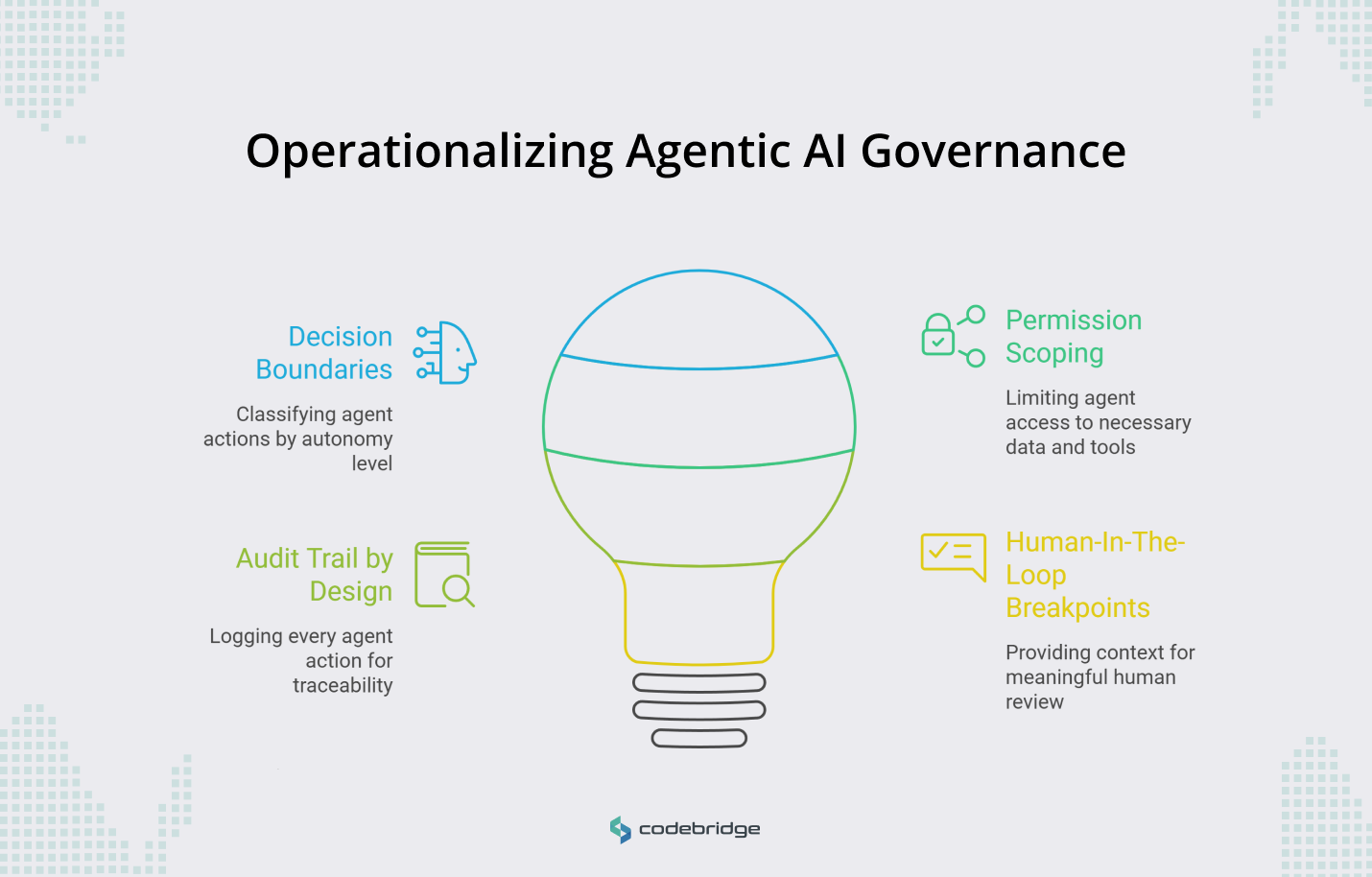
Diagram titled “Operationalizing Agentic AI Governance” showing a central lightbulb surrounded by four governance components: Decision Boundaries, Permission Scoping, Audit Trail by Design, and Human-In-The-Loop Breakpoints, each paired with a short explanation of how agent behavior is constrained and reviewed in production.
Operationalizing agentic AI governance requires four architectural controls: decision boundaries for autonomy, permission scoping for access, audit trails for traceability, and human-in-the-loop breakpoints for meaningful review.

Four design patterns make governance operational. Each maps to a function in NIST's AI RMF. None requires a dedicated governance team. They require engineering decisions during system design.

Decision Boundaries 

NIST calls this "human-AI teaming." You classify agent actions by autonomy level before you write any agent code. Some actions the agent executes on its own: formatting a report, summarizing a dataset. Some of it recommends: flagging a transaction for review, suggesting a treatment adjustment. Sometimes it escalates: any action above a dollar threshold, any decision in a regulated workflow.

The EU AI Act, which entered into force in August 2024 and phases in through 2026, requires human oversight mechanisms for high-risk AI systems. If you sell into European markets, these boundaries are a legal requirement. If you do not, they are still an engineering safeguard. Without them, you discover the agent's actual decision scope during an incident, not during design.

Permission Scoping 

OWASP added "excessive agency" to its Top 10 for LLM Applications in the 2025 update. The risk: an agent with access to tools and data it does not need for the current task. The fix is the same principle you apply to any microservice. Scope the agent's data access and API permissions per session, per task. If the agent handles customer support queries, it should not hold write access to billing records. This is least-privilege, applied to a new kind of service.

Audit Trail by Design 

Gartner's AI TRiSM framework emphasizes traceability and explainability as operational requirements. Every agent action needs a log entry that captures the input, the reasoning chain, the output, and the confidence signal. These logs should be queryable in production, structured for both debugging and compliance review.

When a regulator, a customer, or your own incident response team asks "why did the agent do that," you need an answer within hours, not a three-week forensic reconstruction. Teams that skip audit logging at build time end up reconstructing it from application logs and database snapshots, a slow and unreliable process.

Human-In-The-Loop Breakpoints 

Codebridge’s human varification distinguishes between meaningful human control and rubber-stamp approval. A breakpoint works only if the reviewer receives enough context to make a real decision in under thirty seconds: the agent's proposed action, the data it used, the alternatives it considered. If you design the breakpoint as a modal dialog with a yes/no button and no context, reviewers will click "yes" on autopilot. You will have the compliance checkbox without the actual oversight.

Build the review interface alongside the agent, not after the agent ships.

The Cost of Retrofitting

McKinsey's data shows that organizations with mature AI governance are 1.5 times more likely to report positive ROI from AI initiatives. The inverse tells you what retrofitting costs.

Consider a HealthTech product that shipped an agent handling patient triage without structured audit logging. The agent worked. Six months later, regulators asked for decision records. The team spent three months rebuilding the agent's execution layer to produce the logs that should have existed from day one. Feature work stopped. The compliance deadline drove the roadmap.

A FinTech parallel: an agent that auto-approved low-value transactions without explicit decision boundaries. A false positive triggered a compliance review. The team discovered they could not explain which transactions the agent had approved, on what basis, or where the threshold lived in the code. They redesigned the entire workflow.

Both teams had policies. Neither team had systems that enforced those policies at runtime. The cost was engineering time, delayed launches, and eroded trust with customers and regulators. For any company operating in the EU market or targeting regulated domains like HealthTech and FinTech, the EU AI Act's phased deadlines make this a time-boxed problem. You either build compliance into the architecture now or pause feature delivery later to add it.

Practices For Governing Agentic AI Systems: A Starting Point

Before your team builds any agent feature, four questions need to be answered during sprint planning.

  1. What can this agent decide without a human? Define the autonomy tiers and write them into the agent's execution logic. Review the tiers quarterly as the agent's scope expands.
  2. What is the minimum data and API access this agent needs? Scope permissions per task. Treat the agent as an untrusted service in your architecture, because from a security perspective, it is one.
  3. What do you log, and who can query it? Design the audit schema before you design the agent's output format. Your future incident responders and compliance reviewers are the users of this data.
  4. Where does a human review, and what context do they need? Build the review interface as a first-class component, not a bolted-on approval screen.

Codebridge offers a deeper structure for teams that want to formalize this further. But these four questions cover the architectural surface area that most teams miss.

Conclusion

The teams that treated governance as architecture from the start will spend their engineering hours on new capabilities. The teams that deferred it will spend those hours rebuilding existing systems under regulatory or operational pressure. McKinsey's 1.5x ROI gap between governed and ungoverned AI programs reflects this divergence.

AI agent governance is a system design practice. You can run it with the team you have, in the sprint cadence you already use. The cost of starting now is a few hours of planning per feature. The cost of starting later is months of rework on systems that are already in production.

You do not need a governance committee. You need four answered questions per agent feature, starting with the one your team is building now.

Need to review governance in the system design?

Explore Codebridge’s AI services →

What is agentic AI governance in practice?

Agentic AI governance is presented in the article as a system design practice, not a policy document. It becomes real only when constraints are enforced through architecture, including runtime controls, decision boundaries, permission scoping, auditability, and human review points.

Why is AI agent governance an architecture problem rather than a policy problem?

The article argues that policies describe intent, but they do not constrain what an agent can actually do at runtime. If an agent still has broad permissions or no enforced review path, the policy has no practical effect.

What are decision boundaries in agentic AI systems?

Decision boundaries define which actions an agent can execute on its own, which actions it can recommend, and which actions must escalate to a human. The article frames this as a design decision that should be made before agent code is written.

Why does permission scoping matter for AI agents?

Permission scoping matters because agents should only have access to the tools, data, and APIs required for the current task. The article treats this as least-privilege applied to a new kind of service, reducing the risk of excessive access.

What should an audit trail for an AI agent include?

According to the article, every agent action should generate a log entry that captures the input, the reasoning chain, the output, and the confidence signal. Those logs should be queryable in production for debugging and compliance review.

What makes human-in-the-loop oversight effective in agentic AI workflows?

The article says human review only works when reviewers get enough context to make a real decision quickly. That includes the proposed action, the data used, and the alternatives considered, rather than a simple approval screen with no context.

What questions should teams answer before building an AI agent feature?

The article gives four starting questions for sprint planning: what the agent can decide without a human, what minimum data and API access it needs, what should be logged and who can query it, and where human review should happen with enough context to be meaningful.

Office scene viewed through glass, showing a professional working intently at a laptop in the foreground while another colleague works at a desk in the background.

Heading 1

Heading 2

Heading 3

Heading 4

Heading 5
Heading 6

Lorem ipsum dolor sit amet, consectetur adipiscing elit, sed do eiusmod tempor incididunt ut labore et dolore magna aliqua. Ut enim ad minim veniam, quis nostrud exercitation ullamco laboris nisi ut aliquip ex ea commodo consequat. Duis aute irure dolor in reprehenderit in voluptate velit esse cillum dolore eu fugiat nulla pariatur.

Block quote

Ordered list

  1. Item 1
  2. Item 2
  3. Item 3

Unordered list

  • Item A
  • Item B
  • Item C

Text link

Bold text

Emphasis

Superscript

Subscript

AI
Rate this article!
Thank you! Your submission has been received!
Oops! Something went wrong while submitting the form.
76
ratings, average
4.9
out of 5
April 1, 2026
Share
text
Link copied icon

LATEST ARTICLES

AI in education classroom setting with students using desktop computers while a teacher presents at the front, showing an AI image generation interface on screen.
April 17, 2026
|
8
min read

Top AI Development Companies for EdTech: How to Choose a Partner That Can Ship in Production

Explore top AI development companies for EdTech and learn how to choose a partner that can deliver secure, scalable, production-ready AI systems for real educational products.

by Konstantin Karpushin
EdTech
AI
Read more
Read more
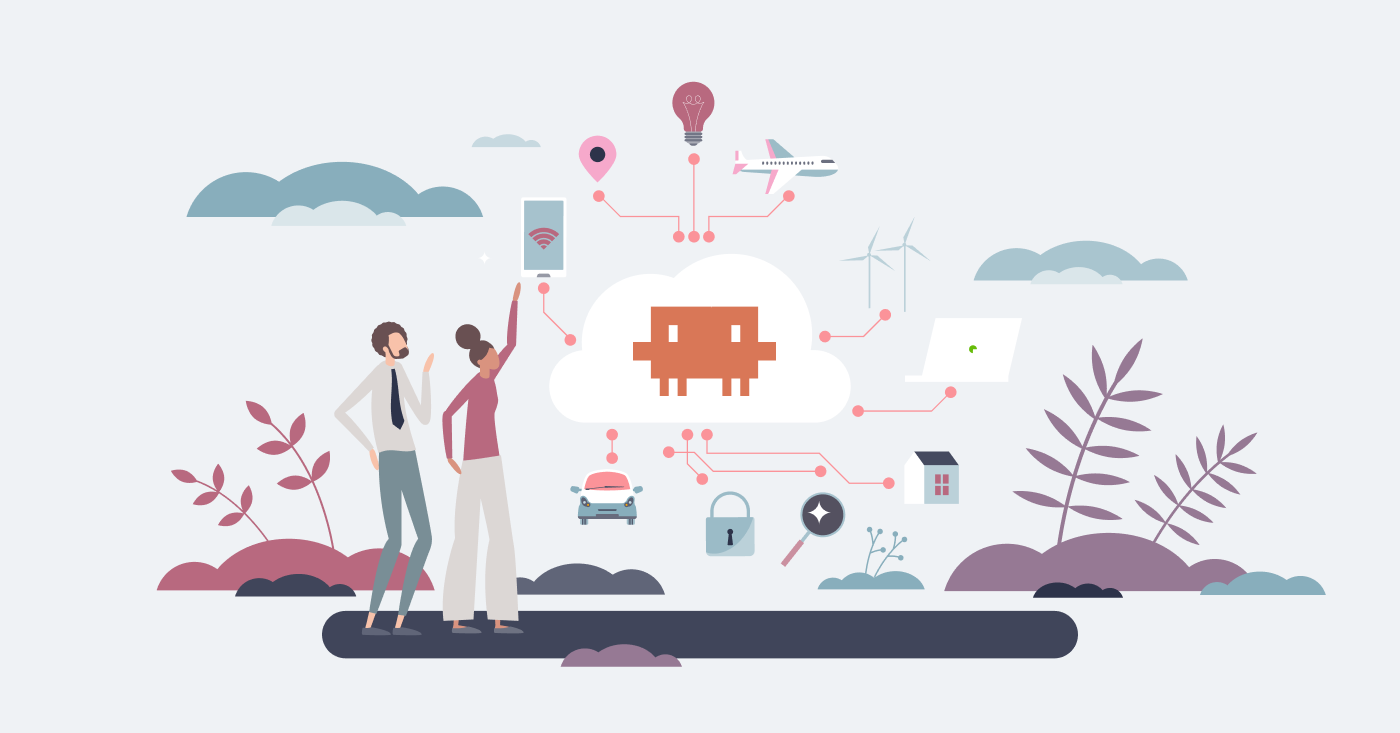
Illustrated scene showing two people interacting with a cloud-based AI system connected to multiple devices and services, including a phone, laptop, airplane, smart car, home, location pin, security lock, and search icon.
April 16, 2026
|
7
min read

Claude Code in Production: 7 Capabilities That Shape How Teams Deliver

Learn the 7 Claude Code capabilities that mature companies are already using in production, from memory and hooks to MCP, subagents, GitHub Actions, and governance.

by Konstantin Karpushin
AI
Read more
Read more
Instructor presenting AI-powered educational software in a classroom with code and system outputs displayed on a large screen.
April 15, 2026
|
10
min read

AI in EdTech: Practical Use Cases, Product Risks, and What Executives Should Prioritize First

Find out what to consider when creating AI in EdTech. Learn where AI creates real value in EdTech, which product risks executives need to govern, and how to prioritize rollout without harming outcomes.

by Konstantin Karpushin
EdTech
AI
Read more
Read more
Stylized illustration of two people interacting with connected software windows and interface panels, representing remote supervision of coding work across devices for Claude Code Remote Control.
April 14, 2026
|
11
min read

Claude Code Remote Control: What Tech Leaders Need to Know Before They Use It in Real Engineering Work

Learn what Claude Code Remote Control is, how it works, where it fits, and the trade-offs tech leaders should assess before using it in engineering workflows.

by Konstantin Karpushin
AI
Read more
Read more
Overhead view of a business team gathered around a conference table with computers, printed charts, notebooks, and coffee, representing collaborative product planning and architecture decision-making.
April 13, 2026
|
7
min read

Agentic AI vs LLM: What Your Product Roadmap Actually Needs

Learn when to use an LLM feature, an LLM-powered workflow, or agentic AI architecture based on product behavior, control needs, and operational complexity.

by Konstantin Karpushin
AI
Read more
Read more
OpenClaw integration with Paperclip for hybrid agent-human organizations
April 10, 2026
|
8
min read

OpenClaw and Paperclip: How to Build a Hybrid Organization Where Agents and People Work Together

Learn what usually fails in agent-human organizations and how OpenClaw and Paperclip help teams structure hybrid agent-human organizations with clear roles, bounded execution, and human oversight.

by Konstantin Karpushin
AI
Read more
Read more
group of professionals discussing the integration of OpenClaw and Paperclip
April 9, 2026
|
10
min read

OpenClaw Paperclip Integration: How to Connect, Configure, and Test It

Learn how to connect OpenClaw with Paperclip, configure the adapter, test heartbeat runs, verify session persistence, and troubleshoot common integration failures.

by Konstantin Karpushin
AI
Read more
Read more
Creating domain-specific AI agents using OpenClaw components including skills, memory, and structured agent definition
April 8, 2026
|
10
min read

How to Build Domain-Specific AI Agents with OpenClaw Skills, SOUL.md, and Memory

For business leaders who want to learn how to build domain-specific AI agents with persistent context, governance, and auditability using skills, SOUL.md, and memory with OpenClaw.

by Konstantin Karpushin
AI
Read more
Read more
OpenClaw and the future of personal AI infrastructure with user-controlled systems, local deployment, and workflow ownership
April 7, 2026
|
6
min read

What OpenClaw Reveals About the Future of Personal AI Infrastructure

What the rise of OpenClaw reveals for businesses about local-first AI agents, personal AI infrastructure, runtime control, and governance in the next wave of AI systems.

by Konstantin Karpushin
AI
Read more
Read more
OpenClaw vs SaaS automation comparison showing differences in control, deployment architecture, and workflow execution
April 6, 2026
|
10
min read

OpenClaw vs SaaS Automation: When a Self-Hosted AI Agent Actually Pays Off

We compared OpenClaw, Zapier, and Make to see when self-hosting delivers more control and when managed SaaS automation remains the smarter fit for businesses in 2026.

by Konstantin Karpushin
AI
Read more
Read more
Logo Codebridge

Let’s collaborate

Have a project in mind?
Tell us everything about your project or product, we’ll be glad to help.
call icon
+1 302 688 70 80
email icon
business@codebridge.tech
Attach file
By submitting this form, you consent to the processing of your personal data uploaded through the contact form above, in accordance with the terms of Codebridge Technology, Inc.'s  Privacy Policy.

Thank you!

Your submission has been received!

What’s next?

1
Our experts will analyse your requirements and contact you within 1-2 business days.
2
Out team will collect all requirements for your project, and if needed, we will sign an NDA to ensure the highest level of privacy.
3
We will develop a comprehensive proposal and an action plan for your project with estimates, timelines, CVs, etc.
Oops! Something went wrong while submitting the form.