NEW YEAR, NEW GOALS:   Kickstart your SaaS development journey today and secure exclusive savings for the next 3 months!
Check it out here >>
White gift box with red ribbon and bow open to reveal a golden 10% symbol, surrounded by red Christmas trees and ornaments on a red background.
Unlock Your Holiday Savings
Build your SaaS faster and save for the next 3 months. Our limited holiday offer is now live.
White gift box with red ribbon and bow open to reveal a golden 10% symbol, surrounded by red Christmas trees and ornaments on a red background.
Explore the Offer
Valid for a limited time
close icon
Logo Codebridge
AI

Agentic AI Era in SaaS: Why Enterprises Must Rebuild or Risk Obsolescence

January 27, 2026
|
8
min read
Share
text
Link copied icon
table of content
photo of Myroslav Budzanivskyi Co-Founder & CTO of Codebridge
Myroslav Budzanivskyi
Co-Founder & CTO

Get your project estimation!

As organizations move into 2026, the speculative phase of AI adoption has passed. We all remember the experimentation wave of 2024 and the industrialization efforts of 2025 - during which enterprise spending on generative AI reached $37 billion – have given way to a new operational reality.

KEY TAKEAWAYS

Agentic AI demands architectural redesign, not feature additions, as traditional SaaS stacks built for human workflows face a structural ceiling when autonomous agents require real-time, multi-system access.

Legacy request-response models break under goal-driven systems, as agents need to perceive, reason, and act autonomously rather than execute predefined user commands.

Production readiness requires three-layer rebundling, separating systems of record, agent operating systems, and outcome interfaces to support autonomous digital workforces.

Integration strategy trumps model selection, with leading agents showing 50x cost variation and open standards like MCP preventing vendor lock-in across the agentic mesh.

However, for SaaS leaders, this marks a transition into the era of the Agentic Enterprise, where autonomous systems are no longer experimental add-ons but form the core operating logic of competitive organizations.

The critical implication for leadership is that agentic AI cannot be treated as a bolt-on feature or a marginal roadmap enhancement. It represents a structural shift - from a human + application model to an AI agent + API ecosystem. While 2025 focused on proving technical feasibility, 2026 is defined by the more complex challenges of production readiness and deep architectural integration.

If you don't rebuild now, you are building a legacy product by next year.

Why “Adding an AI Agent” Can Break Existing SaaS Architectures 

Traditional SaaS platforms were designed as tightly coupled stacks combining data storage, business logic, and user interfaces optimized for human interaction. These systems rely on human-in-the-loop workflows, where users navigate initiate actions and coordinate processes manually.

For that reason, when companies attempt to “add an agent” on top of these legacy architectures, they encounter a hard structural limit – a legacy ceiling. Research shows that 86% of enterprises require significant technology stack upgrades to deploy AI agents effectively.

86% Research shows that 86% of enterprises require significant technology stack upgrades to deploy AI agents effectively, exposing the limitations of legacy architectures.

Request–Response vs. Goal–Driven Systems: The Core Architectural Mismatch

At the root of many failed agent deployments lies a fundamental mismatch in system logic.

Traditional software operates on a deterministic request-response model: a user performs an action, and the system returns a predefined result. However, agentic AI systems operate differently. They are goal-driven and proactive, capable of perceiving their environment, reasoning through ambiguous problems, and acting autonomously to achieve outcomes.

Traditional Software Agentic AI Systems
Deterministic request-response model Goal-driven and proactive operation
User performs action, system returns predefined result Perceives environment, reasons through ambiguous problems
Human-in-the-loop workflows Autonomous execution to achieve outcomes
Applications increasingly function as CRUD databases Applications function as decision engines

By 2028, agents are expected to evolve into autonomous partners that proactively shape decision-making rather than simply assist with information retrieval, as outlined by Deloitte’s projections on agentic AI in the enterprise.

See How You Can Get AI Agents Without a Complete Platform Overhaul

Let's Talk

Where Platforms Fail First

As organizations scale from isolated pilots to thousands of autonomous digital skills, several structural weaknesses consistently emerge.

Permissions and Access Control

Conventional role-based access control (RBAC) models are insufficient for agents that must query 10–20 core systems simultaneously to maintain operational context. In 2026, platforms require “Know Your Agent” (KYA) permission models that provide agents with governed, auditable access comparable to human users.

Workflow Engines and Feedback Loops

Many enterprises fall into an “80/20 trap,” where 80% of effort is spent building integrations and only 20% on training agents for intelligent workflows. Without a unified orchestration layer, agents cannot iterate autonomously or learn from outcomes.

Observability and Decision Traceability

Agent decisions made in opaque “black box” systems introduce significant legal and reputational risk. Production-grade platforms must log every step of an agent’s reasoning process—providing forensic decision traceability that enables auditing, failure analysis, and human oversight.

Data Contracts and Source-of-Truth Conflicts

Fragmented data landscapes lead agents to act on incomplete or inconsistent information. Effective deployment requires a convergence architecture that unifies operational and analytical data within a single cloud-native platform, ensuring real-time visibility for autonomous systems.

💡

Many enterprises spend 80% of their effort building integrations and only 20% on training agents for intelligent workflows. Without a unified orchestration layer, agents cannot iterate autonomously or learn from outcomes.

The Strategic Mistake: Treating Agents Like Chatbots

A common leadership misstep is equating agents with chatbots. Chatbots assist humans by retrieving or summarizing information. Agents, by contrast, independently execute multi-step tasks.

Currently, 77% of enterprise AI deployments focus on simple automation rather than true agentic collaboration, according to the Anthropic Economic Index. This indicates that many organizations still frame agents as replacement technology instead of autonomous teammates.

Sustainable impact requires rethinking entire workflows - spanning people, processes, and systems - rather than automating isolated tasks.

Non-Determinism Enters the Platform: Risk, Trust, and Control

The non-deterministic behavior of large language models (LLMs) remains a major barrier to enterprise trust. Even with deterministic configurations (temperature = 0), accuracy can vary by up to 15% across identical runs, as documented in recent research.

Reliability declines further when consistency is measured across multiple executions. For example, a GPT-4-based agent may achieve a 60% success rate on a single run (pass@1), but only 25% consistency across eight runs (pass@8), according to findings published on arXiv.

Managing this instability requires robust evaluation frameworks and the deployment of “guardian agents” that monitor, validate, and constrain autonomous decisions in real time.

What Must Change in a Production-Grade SaaS to Support Agents

To support a digital workforce, production-grade SaaS platforms are evolving their architecture into a three-layer model:
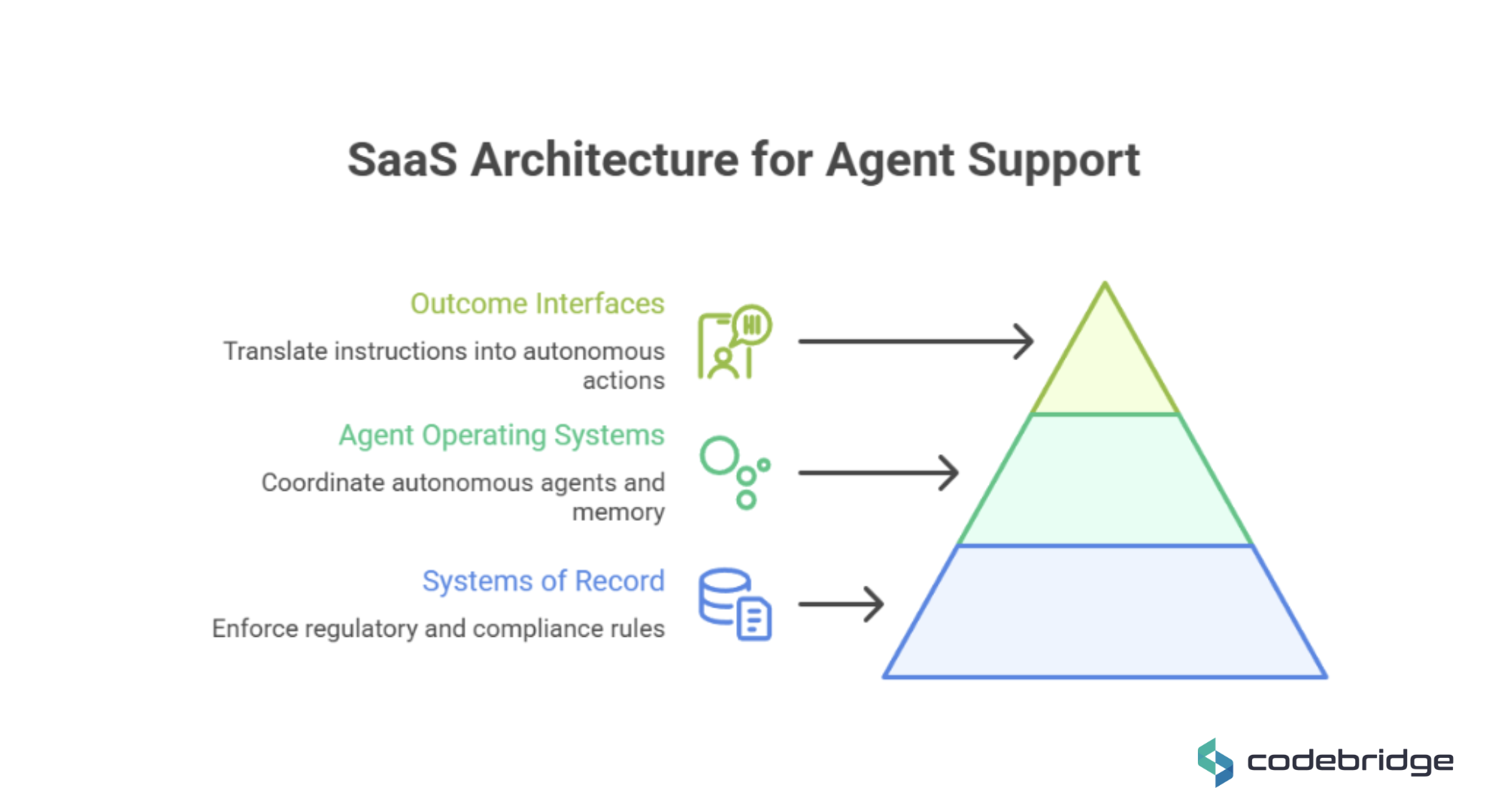
SaaS architecture pyramid for agentic AI support showing three layers: Systems of Record for compliance, Agent Operating Systems for coordination, and Outcome Interfaces for autonomous actions
SaaS architecture pyramid for AI agent support: three-tier framework integrating Systems of Record for compliance, Agent Operating Systems for coordination, and Outcome Interfaces for autonomous execution.

Systems of Record 

These are the core data stores that enforce regulatory and compliance rules, ensuring that all actions are safe, auditable, and reliable.

Agent Operating Systems

Sitting in the middle, this layer handles planning, memory management, and fleet orchestration, effectively coordinating a workforce of autonomous agents.

Outcome Interfaces 

The top layer translates high-level, natural language instructions into autonomous actions, making it easy for users to achieve results without manual intervention.

This shift in architecture also drives a rethink in pricing. Instead of charging per user seat, platforms are moving toward outcome-based pricing, where customers pay for work that gets completed rather than simply for access to the software.

Why Integration Strategy Matters More Than Model Choice

In enterprise SaaS, AI models are becoming increasingly commoditized — the real differentiator is how effectively they integrate into workflows and systems. That’s why, in the agentic economy, model choice is increasingly commoditized, while integration strategy becomes the primary differentiator. According to recent research, leading agents can exhibit up to 50x cost variation for comparable levels of precision.

Relying on a single model constrains adaptability. Instead, organizations benefit from building an agentic AI mesh capable of operating across multiple vendors and model types.

At Codebridge, this approach is supported through the use of open standards such as the Model Context Protocol (MCP) — an open-source framework introduced by Anthropic that provides a standardized way for AI agents to connect with external tools, databases, and data sources. Rather than building custom integrations for each system, MCP enables agents to access and act upon information across disparate platforms through a unified client-server architecture, correlating data seamlessly without vendor lock-in. By establishing a common protocol across different systems, MCP eliminates fragmented integrations and allows agents to retrieve real-time information, execute workflows, and maintain secure interactions with external sources.
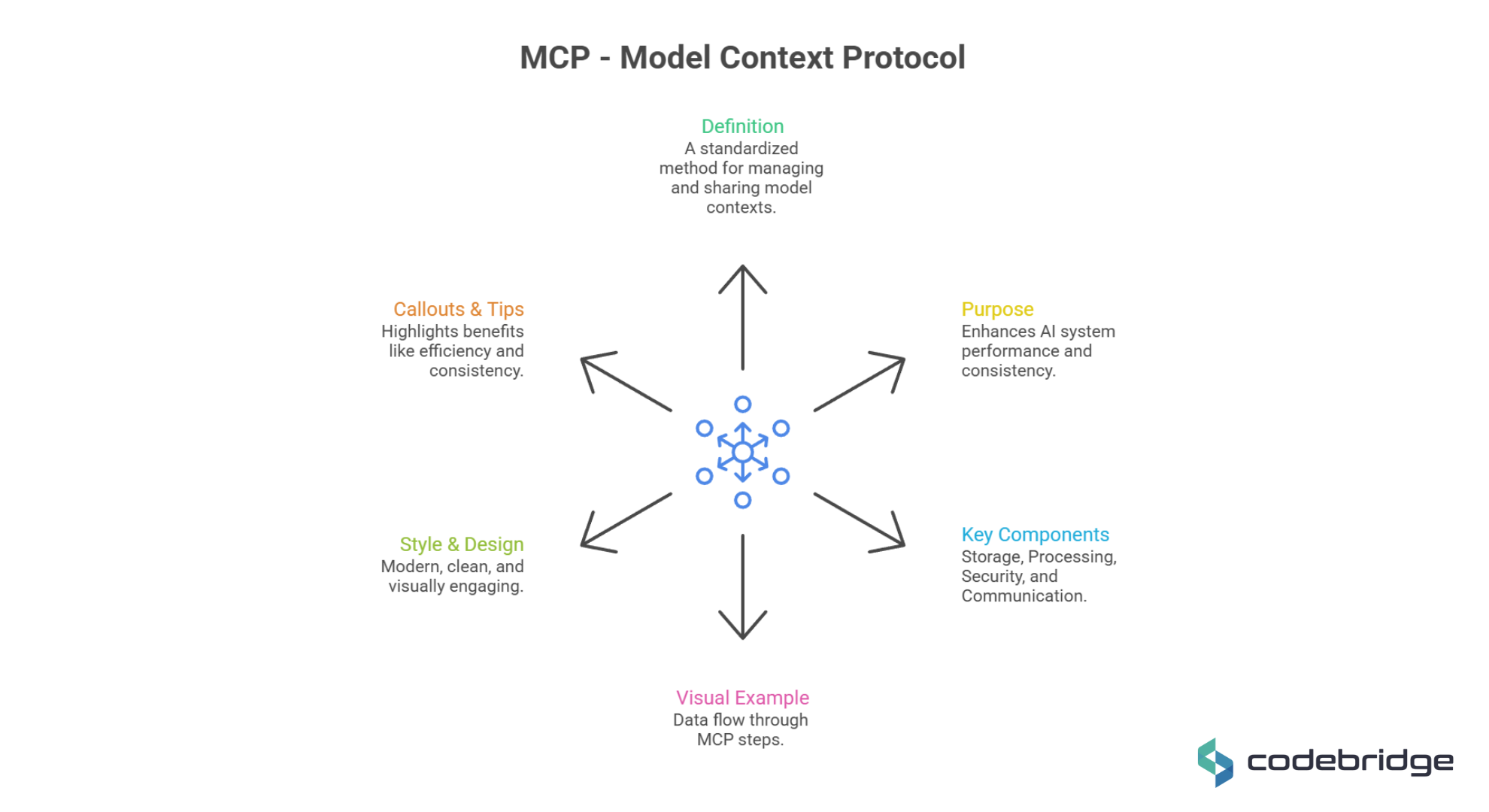
Model Context Protocol (MCP) diagram showing a standardized method for managing AI model contexts with key components including storage, processing, security, and communication for enhanced system performance
MCP optimizes AI performance through standardized context management. The Model Context Protocol integrates storage and processing to ensure consistent cross-system communication.

A Pragmatic Approach to Agentic AI Integration (Codebridge’s Perspective)

To avoid hype-driven failures, Codebridge recommends a phased transformation approach:

Overlay (Days 0–30)
Augment existing workflows with agents for repetitive, single-step tasks to generate early operational value.

As-a-Service (Days 30–90)
Leverage embedded agentic capabilities within established SaaS platforms, such as Salesforce Agentforce.

By-Design (12+ Months)
Re-architect core processes from the ground up as networks of collaborating agents, with human-in-the-loop oversight reserved for exceptions.

Phase Timeline Focus Overlay
Overlay Days 0–30 Augment existing workflows with agents for repetitive, single-step tasks As-a-Service
By-Design Days 30–90 Leverage embedded agentic capabilities within established SaaS platforms By-Design
Re-Architecture 12+ Months Re-architect core processes as networks of collaborating agents

Executive Takeaways: What Breaks First in Your Platform?

  1. Workflows Over Bots
    Redesign entire workflows, not isolated tasks, to achieve meaningful impact.
  2. Invest in Evaluations
    Onboarding an agent resembles hiring an employee. Agents require defined roles, training frameworks, and continuous performance feedback.
  3. Standardize Early
    Adopting open standards such as MCP helps prevent data silos and enables scalable interoperability.
  4. Redefine Success Metrics
    Move beyond traditional productivity measures toward metrics that capture total Return-on-Autonomy (RoA), including unit cost per transaction and first-pass yield.

Conclusion

The transition to the Agentic Enterprise is more than a technical upgrade; it is a fundamental shift in the value proposition of software. For the last two decades, SaaS has been a tool for human efficiency. In 2026 and beyond, SaaS must become an environment for autonomous execution.

The window for "experimental" AI is closing. Organizations that fail to re-architect their core processes around agentic collaboration will find themselves maintaining digital relics - platforms that require too much human effort to remain competitive. At Codebridge, we believe the path forward isn’t found in adding more features, but in building systems that can think, act, and scale independently.

The question for leadership is no longer if agents will run your enterprise, but whether your current architecture is robust enough to let them.

Is your architecture ready for autonomous execution?

Let's Talk

How is agentic AI different from traditional enterprise automation or copilots?

Traditional enterprise automation and AI copilots operate within predefined workflows and require frequent human initiation. Agentic AI, by contrast, is goal-driven and autonomous—it can plan, execute multi-step actions across systems, adapt to changing conditions, and complete outcomes without continuous human input. For executives, the distinction is critical: copilots improve individual productivity, while agentic systems reshape operating models, enabling digital labor that scales independently of headcount.

Why can’t existing SaaS platforms simply “add agents” without rebuilding their architecture?

Most SaaS platforms were designed around human-centric, request–response workflows and tightly coupled application stacks. Autonomous agents require real-time, multi-system access, persistent memory, dynamic permissions, and continuous feedback loops—capabilities legacy architectures were never built to support. Without architectural separation between systems of record, agent orchestration, and outcome interfaces, organizations quickly hit a scalability and governance ceiling, limiting both performance and trust.

What are the biggest risks executives should consider when deploying agentic AI in production?

The primary risks are not model accuracy alone, but governance, observability, and control. Non-deterministic behavior introduces legal, financial, and reputational exposure if decisions cannot be traced or audited. Production-grade deployments require decision traceability, permission frameworks tailored for agents, and real-time oversight mechanisms—often through supervisory or “guardian” agents—to ensure alignment with policy, compliance, and business intent.

How should leaders evaluate readiness for an agentic enterprise transformation?

Executive teams should assess readiness across three dimensions: Architecture: Can systems support autonomous, real-time interaction across the enterprise? Integration strategy: Are open standards in place to avoid vendor lock-in and enable multi-model flexibility? Operating model: Are success metrics shifting from user productivity to outcome-based performance and Return-on-Autonomy (RoA)? Organizations that treat agentic AI as a structural transformation—not a feature upgrade—are best positioned to scale autonomous execution safely and competitively.

AI system concept illustrating decision-making, automation, and intelligent workflow execution

Heading 1

Heading 2

Heading 3

Heading 4

Heading 5
Heading 6

Lorem ipsum dolor sit amet, consectetur adipiscing elit, sed do eiusmod tempor incididunt ut labore et dolore magna aliqua. Ut enim ad minim veniam, quis nostrud exercitation ullamco laboris nisi ut aliquip ex ea commodo consequat. Duis aute irure dolor in reprehenderit in voluptate velit esse cillum dolore eu fugiat nulla pariatur.

Block quote

Ordered list

  1. Item 1
  2. Item 2
  3. Item 3

Unordered list

  • Item A
  • Item B
  • Item C

Text link

Bold text

Emphasis

Superscript

Subscript

AI
Rate this article!
Thank you! Your submission has been received!
Oops! Something went wrong while submitting the form.
24
ratings, average
4.9
out of 5
January 27, 2026
Share
text
Link copied icon

LATEST ARTICLES

secure OpenClaw deployment with configuration control, access boundaries, and operational safeguards for agent systems
April 2, 2026
|
12
min read

Secure OpenClaw Deployment: How to Start With Safe Boundaries, Not Just Fast Setup

See what secure OpenClaw deployment actually requires, from access control and session isolation to tool permissions, network exposure, and host-level security.

by Konstantin Karpushin
AI
Read more
Read more
Office scene viewed through glass, showing a professional working intently at a laptop in the foreground while another colleague works at a desk in the background.
April 1, 2026
|
6
min read

AI Agent Governance Is an Architecture Problem, Not a Policy Problem

AI agent governance belongs in your system architecture, not a policy doc. Four design patterns CTOs should implement before shipping agents to production.

by Konstantin Karpushin
AI
Read more
Read more
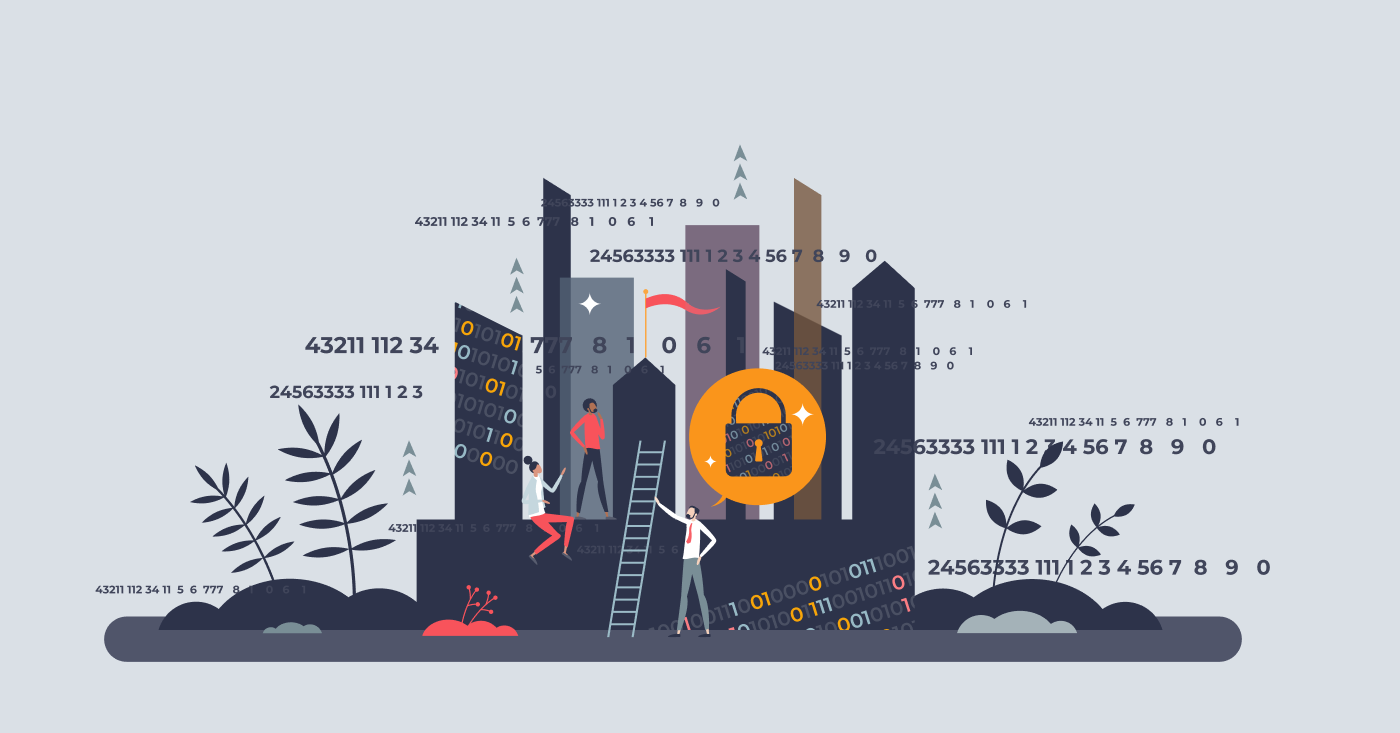
Modern city with AI agent guardrails for production systems. Kill switches, escalation paths, and recovery controls that reduce risk and improve operational resilience.
March 31, 2026
|
8
min read

AI Agent Guardrails for Production: Kill Switches, Escalation Paths, and Safe Recovery

Learn about AI agent guardrails for production systems. Kill switches, escalation paths, and recovery controls that reduce risk and improve operational resilience.

by Konstantin Karpushin
AI
Read more
Read more
CEO of the business company is evaluating different options among AI vendors.
April 3, 2026
|
10
min read

Top 10 AI Development Companies in USA

Compare top AI development companies in the USA and learn how founders and CTOs can choose a partner built for production, governance, and scale. See how to evaluate vendors on delivery depth and maturity.

by Konstantin Karpushin
AI
Read more
Read more
AI agent access control with permission boundaries, tool restrictions, and secure system enforcement
March 30, 2026
|
8
min read

AI Agent Access Control: How to Govern What Agents Can See, Decide, and Do

Learn how AI agent access control works, which control models matter, and how to set safe boundaries for agents in production systems. At the end, there is a checklist to verify if your agent is ready for production.

by Konstantin Karpushin
AI
Read more
Read more
AI agent development companies offering agent architecture, workflow design, and production system implementation
March 27, 2026
|
8
min read

Top 10 AI Agent Development Companies in the USA

Top 10 AI agent development companies serving US businesses in 2026. The list is evaluated on production deployments, architectural depth, and governance readiness.

by Konstantin Karpushin
AI
Read more
Read more
single-agent vs multi-agent architecture comparison showing differences in coordination, scalability, and system design
March 26, 2026
|
10
min read

Single-Agent vs Multi-Agent Architecture: What Changes in Reliability, Cost, and Debuggability

Compare single-agent and multi-agent AI architectures across cost, latency, and debuggability. Aticle includes a decision framework for engineering leaders.

by Konstantin Karpushin
AI
Read more
Read more
RAG vs fine-tuning vs workflow logic comparison showing trade-offs in AI system design, control, and scalability
March 24, 2026
|
10
min read

How to Choose Between RAG, Fine-Tuning, and Workflow Logic for a B2B SaaS Feature

A practical decision framework for CTOs and engineering leaders choosing between RAG, fine-tuning, and deterministic workflow logic for production AI features. Covers data freshness, governance, latency, and when to keep the LLM out of the decision entirely.

by Konstantin Karpushin
AI
Read more
Read more
human in the loop AI showing human oversight, decision validation, and control points in automated workflows
March 24, 2026
|
10
min read

Human in the Loop AI: Where to Place Approval, Override, and Audit Controls in Regulated Workflows

Learn where human approval, override, and audit controls belong in regulated AI workflows. A practical guide for HealthTech, FinTech, and LegalTech leaders.

by Konstantin Karpushin
AI
Read more
Read more
compound AI systems combining models, tools, and workflows for coordinated task execution and system design
March 23, 2026
|
9
min read

Compound AI Systems: What They Actually Are and When Companies Need Them

A practical guide to compound AI systems: what they are, why single-model approaches break down, when compound architectures are necessary, and how to evaluate fit before building.

by Konstantin Karpushin
AI
Read more
Read more
Logo Codebridge

Let’s collaborate

Have a project in mind?
Tell us everything about your project or product, we’ll be glad to help.
call icon
+1 302 688 70 80
email icon
business@codebridge.tech
Attach file
By submitting this form, you consent to the processing of your personal data uploaded through the contact form above, in accordance with the terms of Codebridge Technology, Inc.'s  Privacy Policy.

Thank you!

Your submission has been received!

What’s next?

1
Our experts will analyse your requirements and contact you within 1-2 business days.
2
Out team will collect all requirements for your project, and if needed, we will sign an NDA to ensure the highest level of privacy.
3
We will develop a comprehensive proposal and an action plan for your project with estimates, timelines, CVs, etc.
Oops! Something went wrong while submitting the form.