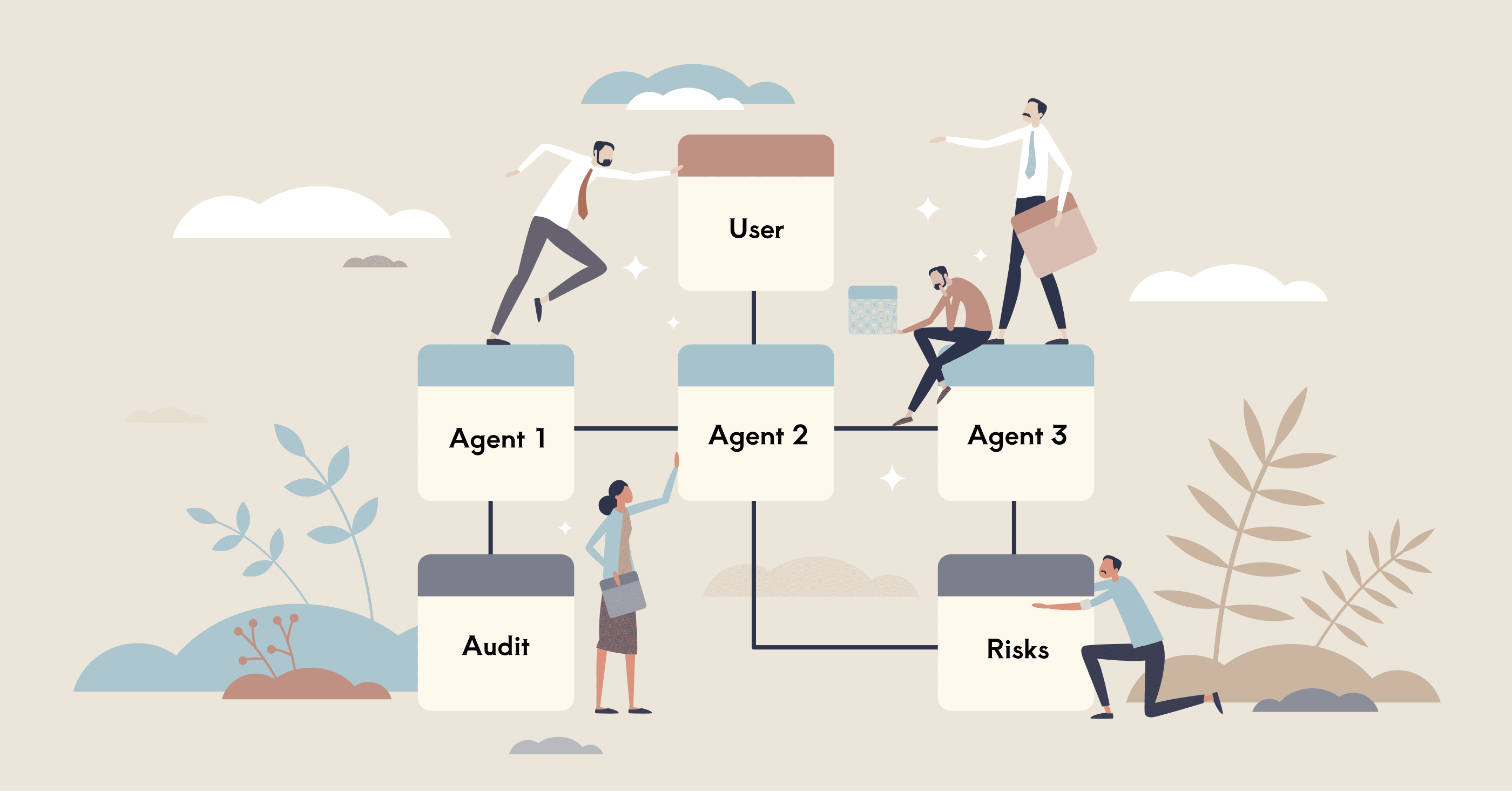


The model did not undo most of the agent systems that failed in production. They were undone by the layer that decided what the model should do next, and what to do when it did the wrong thing. That layer is the multi-agent framework. By 2026, the choice of framework is an architecture decision with the same weight as choosing a database or a message bus. Get it wrong, and the cost shows up later, in the form of workflows that cannot be resumed after a crash, decisions that cannot be audited, and tool calls that cannot be paused for human review.
The decision is also getting harder, not easier. The global multi-agent system market generated USD 7.2 billion in 2024 and is projected to reach USD 375.4 billion by 2034, a 48.6% CAGR. New frameworks ship every quarter. Vendor pitches multiply. Architectural decisions taken now have to hold against workloads that did not exist when the decision was made, on tooling that may or may not still be supported three years out.
This article evaluates the four frameworks most often shortlisted for serious work: LangGraph, CrewAI, the Microsoft Agent Framework, and the OpenAI Agents SDK. The evaluation is built around the questions a CTO actually has to answer before signing off, not the ones that look good in a demo.
The Real Decision Criteria: What CTOs Should Compare Before Choosing
Before evaluating specific tools, technical leaders must establish a framework for the evaluation itself. Eight criteria do most of the work in this decision. The first five describe how the system runs in production. The last three describe how it fits the team and the stack that will operate it.
1. Orchestration Model
The orchestration model determines how work is planned and delegated. Frameworks generally fall into four categories:
- Graph-based: Explicitly defined nodes and edges, modeling agents as state machines.
- Role-based: Metadata-heavy agents that collaborate as a "team" based on descriptions.
- Event-driven/Actor-model: Asynchronous message exchanges between independent components.
- Handoff-centric: Minimalist loops where Agent A explicitly transfers control to Agent B.
2. State and Memory
The model for what happens to work in flight when the host restarts. Three layers matter: short-term context inside an active call, long-term memory across sessions, and durable execution. Durable execution is a checkpoint after every step that lets the workflow resume from where it crashed. The first two are table stakes. The third is the line that separates frameworks that can run a 20-step workflow in production from frameworks that have to restart from step one and burn the tokens for the previous nineteen.
3. Human-in-the-Loop (HITL) Control
The mechanism for pausing execution at a defined boundary, holding state, and resuming with state intact when a human signs off. The test is concrete: a tool call that moves money or modifies a customer record should not run without authorization. Frameworks that model that boundary as a first-class primitive (an interrupt, a wait state, an approval gate) are workable. Frameworks where the team has to bolt the gate on with custom code and external queues are not. Every new high-stakes tool becomes another bespoke integration.
4. Observability and Debugging
The ability for an engineer to reconstruct what the agent did, why, and where it went wrong. Agent failures take a different shape from deterministic failures. The system completes the task ten times in a row and then takes a wrong turn on the eleventh because of one ambiguous input. Without a trace of the trajectory, every tool call, and every state transition, the team has no way to point at the cause.
5. Tool Governance
Agents should not have unfettered access to business systems. The framework must facilitate strict control over tool schemas, authentication, and permissioning. Increasingly, this involves support for the Model Context Protocol (MCP) to standardize tool interfaces.
6. Enterprise Integration
The fit between the framework and the existing stack. Language support is the obvious axis (Python, .NET, Java, Go), but the operational axis matters more: identity providers, secrets management, deployment targets, observability backends. A framework that ships with first-class support for the team's cloud and identity stack saves months of integration work.
7. Vendor and Model Lock-In
The framework should allow for model portability. Some frameworks are optimized for a specific model family (OpenAI, Anthropic), while others provide a provider-neutral abstraction layer.
8. Team Capability
Powerful, low-level frameworks require high engineering maturity. Simpler abstractions may accelerate initial pilots but can limit precise control as the system scales.
LangGraph: Best for Controlled, Stateful, Production-Grade Agent Workflows

LangGraph is a low-level orchestration framework that models agents as state machines. Nodes are functions, edges are state-conditional transitions, and the entire workflow runs against a typed state object that the framework manages. It is the framework that takes the operating contract from the previous section most seriously, and it is also the framework that asks the most from the team operating it.
Best Fit and Execution Realities
Durable execution is the architectural property. After every node executes, LangGraph writes a checkpoint of the full state to a configurable backend (Postgres, Redis, or in-memory for development). If the host crashes mid-workflow, the next run resumes from the last completed node with state intact. For a 20-step workflow that has already burned tokens through step 12, this is the difference between a graceful resume and a from-scratch replay. For workflows that span hours or days, it is the difference between viable and non-viable.
Time-travel debugging is the operational property that follows from durable execution. Because every state transition is checkpointed, an engineer can roll back to any prior step, modify the state, and replay execution under different inputs.
When an agent reaches a wrong conclusion in production, the team can reconstruct the state at the point of divergence, identify the input that caused it, and validate a fix against the same checkpoint. For regulated industries where decisions need to be reproducible after the fact, this is the closest thing to a deterministic audit trail that an agentic system offers.
Performance and Trade-offs
In benchmarking, LangGraph demonstrates the highest reliability for complex, multi-step tasks:
- 96% error recovery rate for complex tasks in benchmarking.
- Approximately 70% error recovery rate for conversational frameworks in comparable scenarios.
- Higher reliability when workflows require structured routing, state management, and recovery from failed steps.
- 4.2 LLM calls for equivalent tasks when using LangGraph’s deterministic routing.
- More than 20 LLM calls in some conversational frameworks due to retries and less structured execution.
- Better token efficiency, because deterministic routing reduces unnecessary conversational loops and repeated model calls.
What It Costs
Setup is verbose in specific ways. The team writes explicit state schemas (typically TypedDict or Pydantic models), wires every edge by hand, configures a checkpointer with the right backend for the deployment target, and implements interrupt handlers if the workflow has approval gates. None of this is hard in isolation; it adds up to a meaningful amount of code before the first agent runs. A workflow that would be 50 lines in CrewAI is often 200 in LangGraph.
CrewAI: Best for Role-Based Agent Collaboration and Faster Workflow Design
CrewAI models agent collaboration as a team of role-defined specialists. The developer writes agents as roles ("Researcher," "Writer," "Reviewer") with goals, backstories, and assigned tools, and the framework handles delegation between them. The model is intuitive in a way that LangGraph deliberately is not. A workflow that takes 200 lines of state machine wiring in LangGraph often takes 30 lines of role definitions in CrewAI.
What the Role Model Gets Right
Some workflows decompose naturally into specialist roles.
- Content operations: a researcher pulls source material, a writer drafts, a reviewer edits.
- Sales development: a prospector qualifies, a writer personalizes, a sender dispatches.
- Internal research pipelines that synthesize across sources.
These workflows share a property that makes the role model work: the cost of an occasional non-deterministic outcome is low. A draft that takes a different angle than expected is a revision, not an incident. A research summary that emphasizes different sources is still useful.
The role model also accelerates pilot delivery in ways that matter for early-stage projects. Stakeholders read agent definitions and understand them; product managers can specify behavior in language that maps directly to the code. For a team that needs to demonstrate viability in six weeks, the speed of authoring is a meaningful advantage.
Where the Role Model Breaks
Roles delegate to each other based on the framework's interpretation of which agent should handle the next step. In a clean workflow, this works, but in a workflow with ambiguity, it produces what teams call delegation loops.
The Researcher passes a task to the Writer, the Writer decides it needs more research and passes it back, the Researcher refines and passes it forward, the Writer escalates to the Reviewer, and the Reviewer routes back to the Researcher. Each pass is a model call. Each call costs tokens. The workflow may eventually converge, or it may not, and the team has limited tools for forcing it to.
The deeper problem is that the role abstraction hides the control flow. A LangGraph workflow makes its transitions explicit; a CrewAI workflow expresses them implicitly through agent descriptions and goals. When the workflow misbehaves in production, the team is debugging by editing prompts and backstories rather than by inspecting state transitions. This works until it doesn't.
Flows
CrewAI's answer to this is Flows, an event-driven layer that sits above the role-based crew and provides explicit state, conditional branching, and deterministic routing. Flows are the structural acknowledgment that role-based collaboration alone is not enough for production-grade workflows. The recommended pattern in 2026 is to use Flows for the orchestration spine and crews for the specialist work inside individual flow steps. Teams that adopt CrewAI without adopting Flows tend to hit the determinism problem within a few months of going live.
Governance and Enterprise Fit
The AMP Suite is CrewAI's enterprise tier, with SSO, role-based access control, SOC 2 compliance, and a unified control plane for managing multiple crews across an organization. For a buyer evaluating CrewAI against criterion 6 (enterprise integration), this is the relevant surface. The open-source framework on its own does not meet the governance bar most regulated buyers need; AMP Suite closes that gap at the cost of a commercial relationship with the vendor.
Where It Fits
Microsoft Agent Framework: Best for Enterprise and Azure-Centric Agent Systems
The Microsoft Agent Framework is the orchestration layer for organizations operating on Azure. It consolidates the work that came out of two earlier Microsoft projects, AutoGen for multi-agent orchestration patterns, and Semantic Kernel for enterprise integration surface, into a single framework intended for long-running distributed systems. For teams already in the Microsoft ecosystem, it is the framework that costs the least to integrate.
Best Fit and Execution Realities
Cross-Language interop is the differentiator. The Microsoft Agent Framework supports both Python and .NET as first-class authoring languages, and agents written in either can participate in the same workflow. No other framework on the shortlist offers this. For organizations with a Python data science team and a .NET engineering team, the alternative is either rewriting Python prototypes in .NET for production, or maintaining two parallel agent stacks. Both are real costs that this framework removes.
The interop matters most in regulated and operationally mature organizations, where .NET often carries the production-critical surface (financial systems, health record systems, identity-bound services) and Python carries the research and modeling surface. A framework that lets a .NET service host the orchestration and call into Python agents for specialized tasks is a meaningful architectural option that no other framework on the shortlist provides.
Migration from AutoGen or Semantic Kernel
This is the operational question for any organization that has already invested in Microsoft's earlier agent tooling. The honest answer is that migration is not free. AutoGen's conversation patterns map onto the new framework but require explicit rewrites; Semantic Kernel's plugin model carries forward more cleanly, but the orchestration layer above it is different. Teams with significant AutoGen investments should expect a real migration project, not a configuration swap. The Microsoft Agent Framework is the strategic destination, but reaching it costs engineering time that the original code didn't.
Cost Posture
Azure-aligned architectures carry an Azure-aligned bill. Cosmos DB for state, Azure OpenAI or Azure-hosted models for inference, Application Insights for observability, Entra ID for identity. For organizations already paying for these services as part of a broader Azure footprint, the marginal cost is small. For organizations evaluating this framework as an entry point into Azure, the total cost of ownership is meaningfully higher than running LangGraph on a Postgres checkpointer or CrewAI with self-managed observability.
This is not an argument against the framework; it is a constraint to price into the decision.
Where It Fits
- Best fit for Microsoft-heavy organizations with substantial Azure investment and existing Microsoft infrastructure.
- Strong fit for .NET production systems, especially where agent workflows need to integrate with existing enterprise applications.
- Useful when Microsoft 365, Graph API, or Fabric are part of the integration surface, making native ecosystem alignment valuable.
- Good for cross-language agent participation, where workflows benefit from agents written in different languages or running across different environments.
- Relevant for open-ended tasks where Magentic-One’s orchestrator pattern matches the shape of the problem.
- Weaker fit for cloud-neutral architectures that need to avoid strong dependency on one vendor ecosystem.
- Rarely ideal for AWS- or GCP-first teams, where Azure-native tooling may add unnecessary operational complexity.
- Not the best choice for organizations without an existing Azure relationship, especially if they lack Microsoft infrastructure, governance, or operations experience.
OpenAI Agents SDK: Best for OpenAI-Native Agent Products and Fast Production Pilots
The OpenAI Agents SDK is the minimalist framework on the shortlist. Released in March 2025 as the successor to the experimental Swarm project, it offers a small surface area: agents, tools, handoffs, and guardrails. The implementation philosophy is the inverse of LangGraph. Instead of giving the team a state machine to configure, the SDK gives them a loop with the smallest set of primitives that produce useful behavior. For OpenAI-aligned teams that need to ship fast, this is the right trade. For everyone else, the same minimalism that makes it fast becomes the constraint that limits it.
The Handoff Model
Multi-agent coordination in this SDK happens through handoffs. Typed tool calls that transfer the conversation from one agent to another. Agent A finishes its work, calls transfer_to_agent_B, and Agent B picks up the conversation with full context. There is no shared mutable state between agents and no implicit delegation. Control flow is explicit, traces are linear, and the entire workflow is debuggable as a sequence of well-defined transfers.
This model fits triage workflows naturally. Customer service routing, a generalist agent that hands off to a billing specialist or a technical specialist based on intent, is the canonical use case. Escalation workflows where the early agent handles the easy 80% and the later agent handles the hard 20%. Sales qualification where each handoff represents a stage gate. The model holds well when the workflow is fundamentally a sequence of decisions about which agent should handle the next step.
The model breaks when the workflow needs cycles, when multiple agents need to coordinate on shared state, or when the team needs to reason about the workflow as a graph rather than a sequence. A research workflow that iterates between research and synthesis agents until a quality threshold is met is awkward in handoffs and natural in LangGraph. The SDK is honest about this; it doesn't pretend to be a state machine, but the buyer needs to recognize the limit.
Sandbox Agents
This is the most architecturally interesting capability in the SDK. Sandbox agents run inside isolated container environments with shell access, filesystem access, and the ability to execute code. The model can write a script, run it, observe the output, and iterate. For workflows that involve data analysis, document processing, or any task where the agent needs to manipulate files and verify the result, this is a meaningful capability that no other framework on the shortlist offers natively.
The trade-off is that sandboxes consume compute, they require a container orchestration story, and they expand the attack surface. The SDK manages most of this, but the team running it in production needs to think about sandbox lifecycle, resource limits, and what happens when an agent's code execution loops. For the right workflows, the cost is worth it. For workflows that don't need code execution, sandbox agents are a feature the team won't use.
The Platform Dependency
This is the substantive trade-off. The SDK is optimized for OpenAI's models and APIs. Several features such as real-time voice, the response API integration, certain tool-use modes, sandbox model selection work best or only with OpenAI models. Anthropic and Google models can be wired in for basic agent loops, but feature parity is partial and changes with each SDK release.
OpenAI ships model deprecations on real timelines: the 2024 GPT-4 deprecation forced migrations across deployed systems, the o-series transitions changed pricing and behavior, and the Realtime API has been through multiple breaking iterations since launch. A framework tuned to OpenAI's stack inherits this cadence. Pricing changes affect unit economics directly. Rate limit policies vary by account and aren't fully transparent. A model better-suited for a specific workflow may emerge from another lab and the team has to choose between rewriting or staying on a less-suitable model.
Safety and Guardrails
OpenAI prioritizes built-in safety through a three-tier guardrail system (Input, Output, and Tool guardrails) that runs in parallel with agent execution by default. This architecture prevents "math homework" prompts or malicious inputs from hitting expensive reasoning models, saving time and money in customer-facing environments.
Comparison Table: Which Framework Fits Which Business Case?
When You Should NOT Use a Multi-Agent Framework
Complexity should be a last resort, not a starting point. There are many scenarios where a multi-agent framework is unnecessary and may actually degrade performance.
Do not use a multi-agent framework when:
- A deterministic function suffices: If the logic can be hard-coded into a standard Python or .NET function, an AI agent is an unreliable and expensive substitute.
- Prompt chaining is enough: Level 1 autonomy—where Input A goes to Model A, and its output goes to Model B—is deterministic, predictable, and easier to debug than an autonomous agent loop.
- A single agent with tools can solve the task: A single, well-scoped agent with clear instructions handles 80% of real-world requirements more reliably than a complex multi-agent system.
- Unclear approval boundaries: If the business cannot define when a human should review an agent's decision, deploying multiple autonomous agents creates unmanageable legal and operational risk.
- No observability layer: If the team cannot trace tool calls or inspect state, the system is a "black box" that will be impossible to debug when it inevitably fails.
How to Choose: A CTO-Level Decision Checklist
The four frameworks resolve to four distinct workflow profiles. Match the profile to the workflow.
Choose LangGraph if:
- The workflow has cycles, conditional branches, or retry paths that depend on state.
- The system must survive host restarts without losing in-flight work.
- Compliance, audit, or post-incident review requires reconstructing what the agent did and why.
- A human needs to inspect or modify state mid-workflow before downstream actions fire.
What you accept: meaningful engineering investment in state schemas, edge wiring, and operational tooling. The team owns the framework as infrastructure.
Choose CrewAI if:
- The workflow decomposes into specialist roles (researcher, writer, reviewer; prospector, qualifier, sender).
- The cost of an occasional non-deterministic outcome is low — a draft that takes a different angle is a revision, not an incident.
- The team needs to demonstrate viability fast and stakeholders need to understand the system without reading code.
- The production version uses Flows, not raw crews, as the orchestration spine.
What you accept: less determinism than a state-machine framework. If audit and reproducibility matter at every step, the role model is the wrong abstraction.
Choose Microsoft Agent Framework if:
- The organization runs on Azure and uses Microsoft 365, Graph API, Entra, or Fabric as part of the integration surface.
- Production workflows need to span Python and .NET in the same orchestration layer.
- The workload is open-ended in ways that fit Magentic-One's orchestrator pattern.
- Azure-aligned cost and operational posture is acceptable as part of the broader cloud commitment.
What you accept: Azure infrastructure as a fixed dependency. The framework is rarely worth the migration for non-Azure organizations.
Choose OpenAI Agents SDK if:
- The workflow is fundamentally a sequence of decisions about which agent should handle the next step (triage, escalation, qualification).
- The team has standardized on OpenAI models and intends to stay there.
- The product surface is voice-first, or the workflow needs sandbox-based code execution.
- Speed to a controlled pilot matters more than long-term model portability.
What you accept: platform alignment as a deliberate trade. Model deprecations, pricing changes, and rate limit policies become operational concerns the team manages on OpenAI's timeline.
If the Signal Isn't Clean
Not every buyer reads four checklists and finds one that fits. Two defaults handle the ambiguous cases.
The conservative default is LangGraph. If the workflow has any meaningful complexity, any compliance dimension, or any expectation of running for more than a year, the durability and control LangGraph provides is a safer architectural commitment. The cost is engineering time the team will spend regardless; LangGraph spends it upfront, where the system benefits, instead of in production incidents later.
The default speed is the OpenAI Agents SDK. If the workflow is an OpenAI-aligned pilot, the team can ship in weeks instead of months, and the lock-in is acceptable as a pilot-stage trade. The pilot may need to be rebuilt for production if it grows past the SDK's fit; the speed of getting something running often justifies that risk.
CrewAI is rarely the right pick for a genuinely undecided buyer, it works when the workflow obviously matches the role model and is rarely the safer fallback when it doesn't. The Microsoft Agent Framework is rarely the right pick for a buyer who isn't already Azure-aligned. Both frameworks have strong fit windows; outside those windows, one of the two defaults usually serves the buyer better.
How Codebridge Would Approach the Framework Decision
At Codebridge, we do not start this decision by asking which framework is most popular on GitHub. We begin by mapping the business workflow, identify the highest-risk data touchpoints, and define the expected failure modes.
For production AI systems, the framework is only the top-most layer of the architecture. The harder decisions involve the execution infrastructure underneath: sandboxed environments for code execution, semantic search that returns results in sub-second time, and memory architectures that prune redundant history to save context window space.
We focus on building "Agentic Engineering" models where agents act as digital team members with shared memory and defined roles, but are always governed by a control plane that enforces deterministic business rules. Whether the final choice is LangGraph for its precision or Microsoft for its Azure scale, our objective is "progressive autonomy" – starting with high human involvement and reducing it only as the system proves its reliability through measurable metrics.




Heading 1
Heading 2
Heading 3
Heading 4
Heading 5
Heading 6
Lorem ipsum dolor sit amet, consectetur adipiscing elit, sed do eiusmod tempor incididunt ut labore et dolore magna aliqua. Ut enim ad minim veniam, quis nostrud exercitation ullamco laboris nisi ut aliquip ex ea commodo consequat. Duis aute irure dolor in reprehenderit in voluptate velit esse cillum dolore eu fugiat nulla pariatur.
Block quote
Ordered list
- Item 1
- Item 2
- Item 3
Unordered list
- Item A
- Item B
- Item C
Bold text
Emphasis
Superscript
Subscript